• Writing & Design
    • Poetry
    • Portfolio
    • Essays
  • Photo
    • Portraits of Mother Nature
    • All The World's A Score
    • Magnetic Fields Forever
    • The Light Within Us
    • Landscape
    • Potpourri
  • Video
  • Running
    • San Diego Ultra Running Friends
    • Black Mountain Trail Races
    • Black Mountain Videos
    • Races
    • Strava
  • Music
    • Mine
    • Others
  • Bio
  • Contact
  • Menu

Caryn Sandoval

Adventuring in landscapes of mind & matter
  • Writing & Design
    • Poetry
    • Portfolio
    • Essays
  • Photo
    • Portraits of Mother Nature
    • All The World's A Score
    • Magnetic Fields Forever
    • The Light Within Us
    • Landscape
    • Potpourri
  • Video
  • Running
    • San Diego Ultra Running Friends
    • Black Mountain Trail Races
    • Black Mountain Videos
    • Races
    • Strava
  • Music
    • Mine
    • Others
  • Bio
  • Contact

What I Can Know about What We Can Know by author Ian McEwan

June 11, 2026

It took the first few chapters for me to connect and understand McEwan’s writing. I’m sure much has already been written about his way of painting articulate details about a person, or the way he takes care to not only describe a place, but to then later on explain why describing that place was important. His writing is fastidiously meta; everything serves a purpose, there is no purposeless prose.

Not ironically, a lack of purposeless prose is exactly how he (unexpectedly, to me) concludes the book: with the uncovered (literally) prose of a character being studied by an academic 100 years into the future, after climate change has made the purposefulness of moving forward even more pertinent.

As evidenced by the bemused students he teaches, the past is something to not be learned from. Being obsessed with the past, our main character experiences a fruitlessness from both his work and his daily life.

I never read Atonement. But I have an understanding that part of what makes McEwan’s writing, paradoxically, ephemerally grounded is the push and pull of his characters’ moral flaws. They’re full bodied, like a wine with many flavors that moves your emotions through a tesseract of wanting. There’s a longing in this book that is akin to the character’s longing: everyone longs for something. Our narrator and protagonist Tom longs to discover a poem that will complete his purpose in life; Vivien longs for a stability that she knows does not exist; her world also longs for stability, knowing that the climate is shifting, but not knowing just how truly unstable it is; the later world longs to move past the instability.

What is the craving of stability and why is it so often out of balance with the lust of each character for what they want that they know that they can’t have, that they pursue anyways for the thrill of it?

But we must come back to the title to summarize what I took away from this book, the most: What We Can Know. This story is really about what we can know in three ways:

  • What we can learn from the past when studying it through the media and communications that were available in that time. These media and data shape the importance of information.

  • What we can know about each other when we’re not being empathetic to others needs, or or own, as driven by our lofty goals. Pursuing a dream so fervently that our flaws seep out like oil from the ground.

  • What we, as readers, can know: the writer ends one story as it is seemingly just beginning, thus ending the book with a complete wrap-up of the life story from the character 100 years earlier.

McEwan lets us only know that we can only truly “know” when the story ends, and thus learning from the past requires endings within the past. The climate changed. Vivien burned the poem. Blundy ended her husband’s story.

The pain of our flaws leads us to act in ways that are detrimental to our future, becoming a beautiful cycle that leads to, in my opinion, my biggest takeaway from the book: that the passion of the teachers alone could not convince the students to care about the past; in fact, the passion is what caused them to double down on their beliefs.

What we can know today is only determined by what the past allows us to know; which despite the many ways we communicate, is still metered by the choices that a person makes to reveal their secrets. In McEwan’s world, free will exists, and it is the reason that anything can ever happen at all, flawed or not.

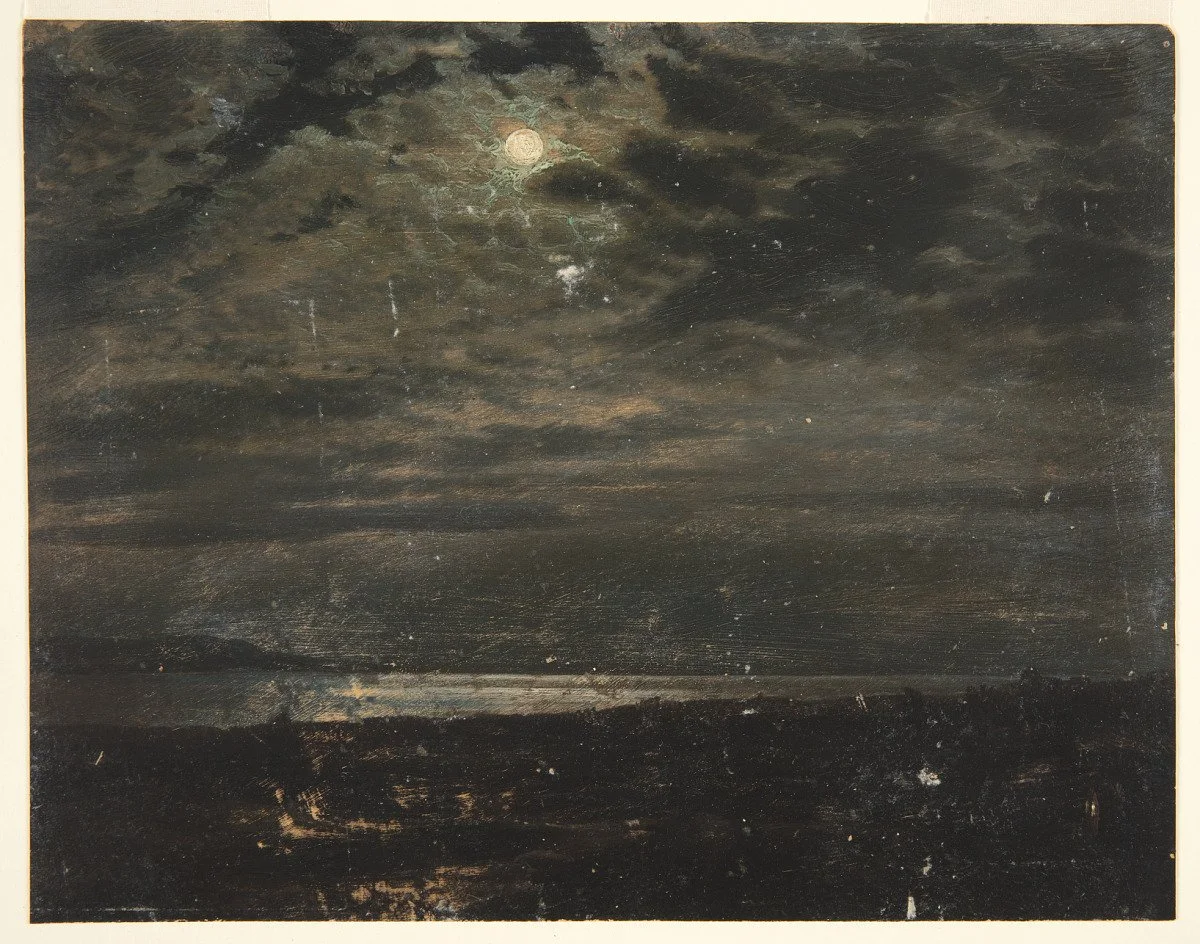
Image: Frederic Edwin Church, American, 1826–1900, Smithsonian

Comment

Notes on the film Brazil by Terry Gilliam (literal notes)

June 02, 2026

I struggle with an essay for this film. I adore it. I had the privilege to see it on a big screen for the first time (and in my eyes for the third) at the Digital Gym Cinema in San Diego. I would like to share my raw notes, and then explain myself to myself afterwards.

Brazil by Terry Gilliam, thoughts:

  • system that only exists to prosecute, wholly defined by how easy it is for everyone to break a law, given how extremely nuanced it is

  • in this kind of system, you exist simply to ensure that laws exist, rather than law existing to ensure humanity exists

  • rules are god

  • secularism gone awry

  • very confused by dichotomy of the female character: she is both a strong-willed woman and a pleasure toy. none of that made any sense to me.

  • so why would someone like her care about someone like him, in a way that causes her to seek her femininity? the only thing i can think of is that she is attracted to his own embracing of breaking rules, but she doesn’t realize that he does that because he thinks he’s immune to them given his privilege

  • implies that a woman may hide her femininity simply because a man hasn’t cared about her, while this could be true for some, it implies that its possible for all.

Looking at these in order, it seems I warmed up to being comfortable stating how I feel about the primary female fantasy character. There are clear ties between my love of rules, but my fear of their impact on my life. I both love and loathe rules. Rules make me feel safe; it’s structure I can function within. I know how to be safe through choice.

I have no intention of breaking the biggest, it’s not my nature; but I fear honest mistakes can lead to catastrophe. This film makes that quite clear. The system itself exists to prosecute rule-breakers. It’s control gone deeply awry. Ironically, a lack of control in societal systems leads to the same problem: being a victim of the errs of the perceived intentions by those in charge.

What I failed to touch upon was this:

  • his mother (one of the only other female-identifying characters, and perhaps the most memorable) requires herself to be young, is this patriarchy response?

In a film dominated by men, I overlooked the women. I am unsure if this was a statement of the film. The female characters are all trapped in a system that gives them no autonomy, and thus less interest unless its body horror (a la the fantastical plastic surgery). They’re sexless and suffering, or aging and suffering, or aloof and suffering, or widowed and suffering. The women suffer, and are things to look at. But they suffer because of the story itself, not because of the film. Even the men in the film who choose to help women suffer.

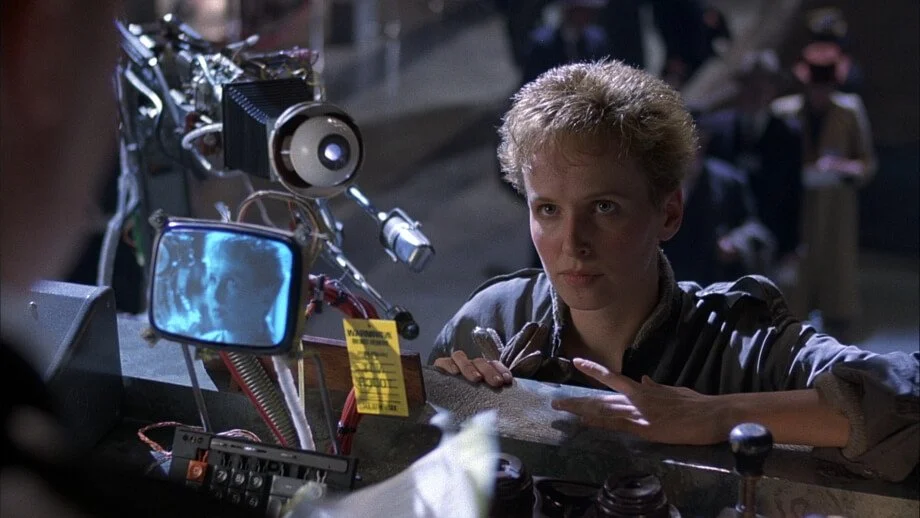
The contraptions and spaces within the film feel probing, like in the image above. I suppose I myself have guarded my femininity in the face of things that expose it unwillingly.

I may be giving it too much. It was the 80’s, the time I was born in and the time I loathed until I entered my mid-30s and stopped hating things, like myself. Maybe I harbor a resentment for the era, as it led to the conditions which led to my own suffering.

This film entered the thriving cinemas of the 80’s a year before I was born. It was a bit of a roadmap for a future: that I was being born into a system of rules, a society of structure that inherently harms women, and a place of endless paperwork and concrete that made me crave nature, sex, beauty, pain, and love more than any goal I ever had.

Brazil’s world is a true nightmare that makes a feeling a fire deep within me.

Comment

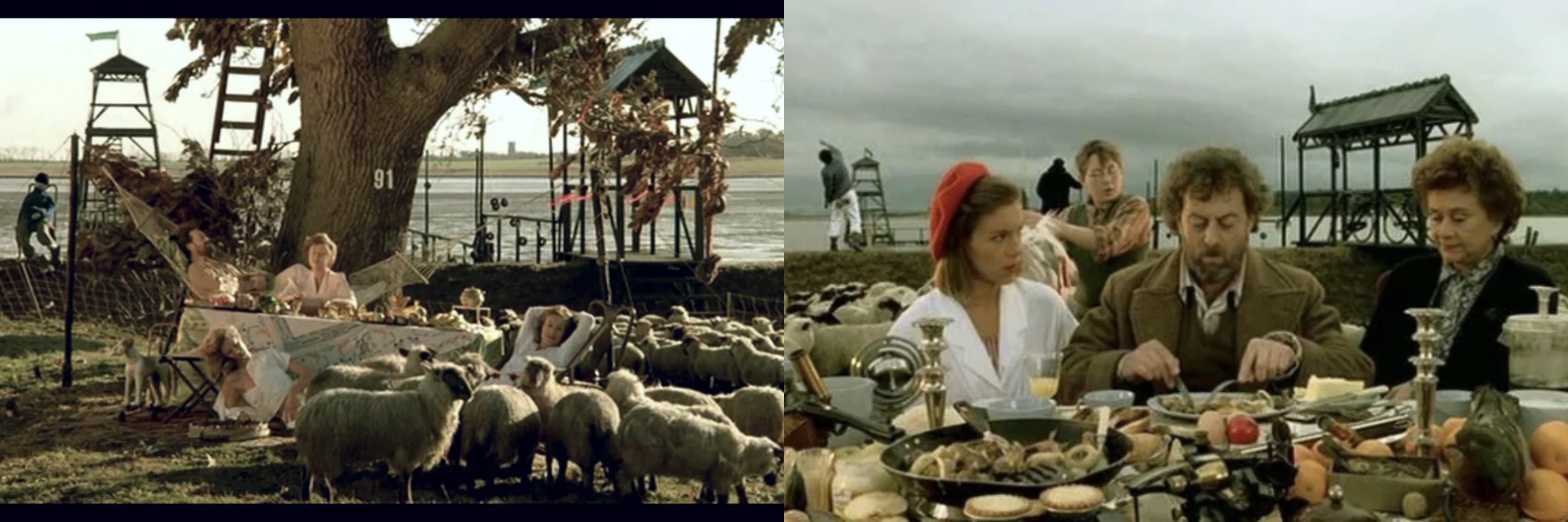
Photo from https://www.sbpg-projects.com/

Summer of free will: A perspective on Greenaway's Drowning by Numbers

May 27, 2026

Stars are central to the theme of Drowning by Numbers, present in the nightsky as they are counted and named out loud in our introduction to the film, and seen sewn into the costuming the young child doing the counting. With all the stars adorning her, perhaps she is more of a personified constellation herself, a perceived character made up by stars.

And so, when she meets her flippantly shocking fate at the end of the film, we are begged by the filmmakers to believe that the death of a star, perhaps even a complex panoply of stars in the form of a constellation, is a banal and expected event in the schematics of a errant universe.

I’ve routed myself ahead of what I would like to say about this film. It has an inherent warmth, both with the candy-colored lighting (even in outdoor scenes) and the glow of summer joy, and a romantic indifference to everything that occurs. Though it gets close to characters, it stays at a distance with its tone, as if we are someone looking up at the stars, unable to truly experience what its like to feel their intense, gnawing heat while floating in space around them.

As a Californian, I’m floating around the New-England-style fertility: gentle comfort and wealth, needing things but not being clear on what they are, and the inherent bounty of the early American experience. I grew up with New England family. I see it from a distance.

From my perspective, I wonder: do we judge these groups of others enjoying their summers on the beach? Or do we look at them as we do a nightsky? Do we surmise blind wealth leading to their problems, or do we see them as part of a larger structure of events that lead from one thing to the next? Characters in this movie appear to have full free will; but they, as untrustworthy nodes in a circuit, are causing the entropy of the film. Is it our fault we are human? Perhaps that’s what defines us: we are conduits of chaos.

Clearly, none of the characters in these films are morally perfect. They thrive in their imperfection and misdeeds. They do what is best for them as that node, even letting their husbands die. Their nonchalance is an inherent aspect of the film’s language. A star can burnout, a star can engulf another, a star is a star is a star and it its cataclysm is certain.

I’m about to shift from my argument.

I write all this with the awareness that you, dear reader, have certainly seen this film. There is so much that has been trivially discussed about its trite and banal approach to death, but what those discussions fail to see is the intention of color: the use of beauty of summertime oranges and yellows, fruits and frothy waves, sand-laden decks and silly family sports. The choice to be free in this film is to see the soul of the summer, which only exists because of our seemingly indifferent nearby star, which will trivially reach it its end in four billion years.

Comment

A dreamer’s philosophy

Looking at cinema and literature through the prism of a dreamer’s romanticism.


Recent posts

Featured
June 11, 2026
What I Can Know about What We Can Know by author Ian McEwan
June 11, 2026
June 11, 2026
June 2, 2026
Notes on the film Brazil by Terry Gilliam (literal notes)
June 2, 2026
June 2, 2026
May 27, 2026
Summer of free will: A perspective on Greenaway's Drowning by Numbers
May 27, 2026
May 27, 2026